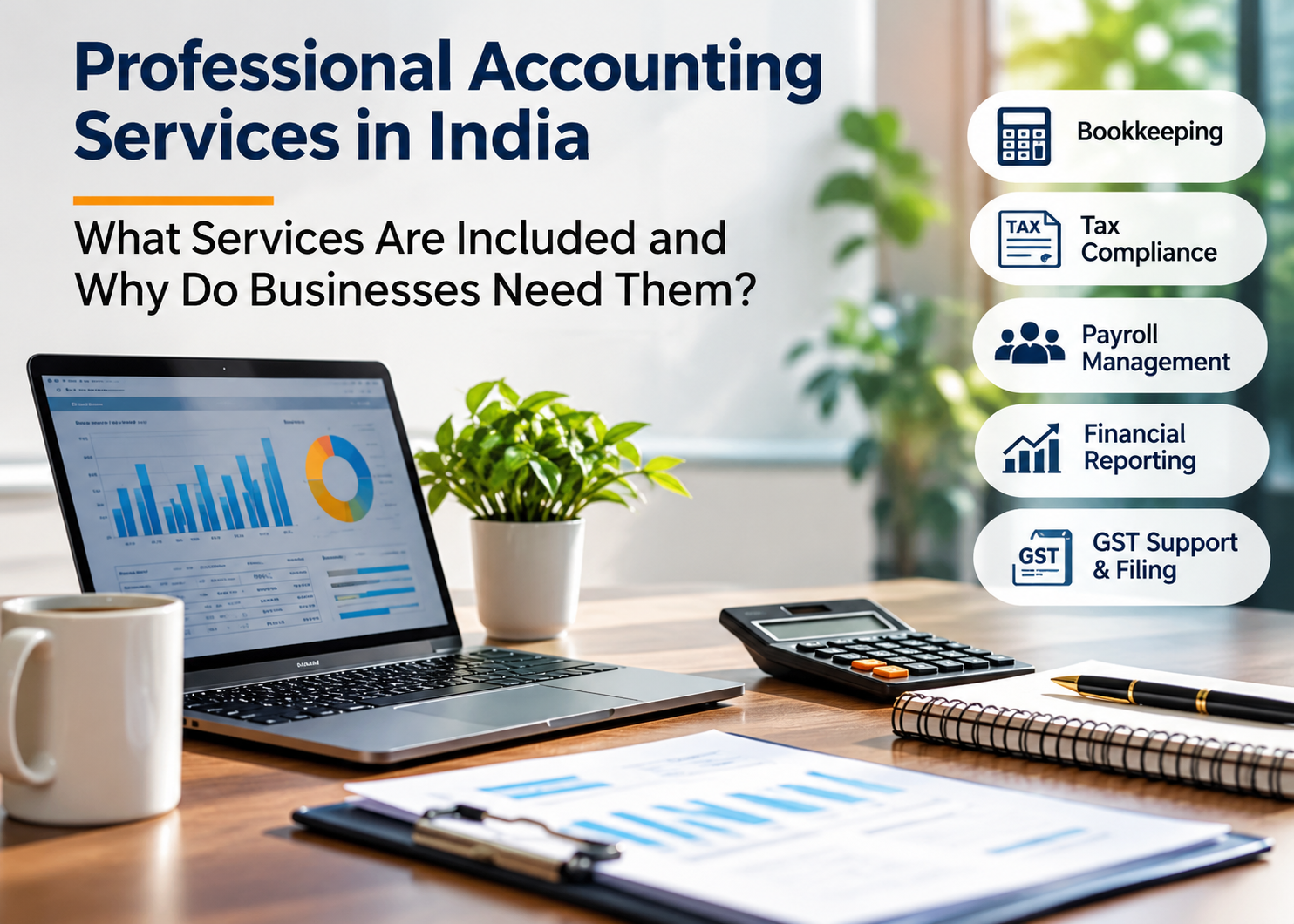
Managing business finances involves much more than recording income and expenses. Every transaction affects financial reporting, tax obligations, cash flow and business decisions. Whether a company operates as a startup, small enterprise or established organisation, maintaining accurate financial records is essential for sustainable growth. professional accounting services in India help businesses organise their financial information, maintain regulatory compliance, monitor expenses and make informed decisions. With expert accounting support from service providers such as esbigdesk, business owners can spend more time managing operations while maintaining better control over their finances.
What Are Professional Accounting Services in India?
Professional accounting services involve the systematic recording, classification, examination and reporting of financial transactions. These services help businesses maintain reliable financial records while meeting applicable tax and statutory requirements.
An accounting professional handles financial activities such as bookkeeping, payroll processing, taxation, financial statement preparation, bank reconciliation and management reporting.
However, the scope of accounting support depends on the nature, size and operational requirements of the business.
For example, a small retail business may require bookkeeping, GST accounting and expense monitoring. A growing manufacturing company may also need inventory accounting, cost analysis, payroll management and detailed financial reporting.
Professional accounting services can be provided by an internal finance department, an outsourced accounting firm or a combination of both.
The main objective is to maintain accurate financial information that supports compliance, operational efficiency and sound financial management.
What Services Are Included in Professional Accounting Services in India?
Businesses require different accounting functions depending on their structure, financial activities and regulatory responsibilities.
The following services are commonly included in professional accounting support.
1. Bookkeeping and Financial Record Maintenance
Bookkeeping forms the foundation of an organised accounting system. It involves recording financial transactions accurately and maintaining supporting documents.
Professional bookkeeping services generally include:
- Recording daily sales and purchase transactions
- Maintaining general ledgers and subsidiary accounts
- Recording business expenses and income
- Organising invoices, receipts and payment records
- Maintaining customer and supplier accounts
- Classifying transactions under appropriate accounting heads
Proper bookkeeping helps businesses identify financial discrepancies, track outstanding balances and maintain dependable records.
For example, when purchases are recorded under incorrect expense categories, management may misinterpret operating costs.
Regular bookkeeping reduces such problems and provides reliable information for financial reporting and taxation.
2. Accounts Payable and Accounts Receivable Management
Managing money owed to suppliers and payments expected from customers is essential for maintaining healthy cash flow.
Accounts payable management focuses on recording supplier invoices, verifying payment obligations and monitoring outstanding bills.
Accounts receivable management involves tracking customer invoices, recording collections and identifying overdue payments.
Professional accountants may assist businesses with:
- Preparing customer invoices
- Monitoring supplier payment deadlines
- Maintaining outstanding balance statements
- Recording customer collections
- Identifying delayed payments
- Reconciling customer and supplier accounts
Effective management of receivables and payables helps businesses plan payments and avoid unnecessary cash shortages.
It also provides greater visibility into working capital requirements.
3. Bank Reconciliation and Transaction Verification
Bank reconciliation involves comparing transactions recorded in accounting books with entries appearing in bank statements.
Differences may arise because of pending deposits, bank charges, duplicate entries, unrecorded payments or timing differences.
Accounting professionals investigate these differences and make necessary corrections.
Businesses using multiple bank accounts, UPI payments, payment gateways or digital collection platforms particularly benefit from regular reconciliation.
Accurate reconciliation helps identify missing transactions, prevent reporting errors and improve the reliability of financial records.
It can also reveal unusual transactions that require further investigation.
4. Financial Statement Preparation
Financial statements provide an organised picture of a company’s financial activities and position.
Professional accountants assist with preparing important financial reports, including:
Profit and Loss Statement: Shows revenue, expenses and profit or loss over a specified accounting period.
Balance Sheet: Presents assets, liabilities and owners’ equity at a particular date.
Cash Flow Statement: Explains cash movements arising from operating, investing and financing activities, where prepared or required.
These statements help owners evaluate financial performance, assess liquidity and monitor business stability.
They may also be required when applying for business loans, approaching investors or meeting statutory reporting obligations.
Accurate financial statements allow management to base decisions on reliable figures rather than estimates.
5. GST Accounting and Return Filing Support
Goods and Services Tax is an important compliance responsibility for businesses registered under GST in India.
Professional accounting support can help registered businesses maintain GST-related records and prepare the information required for return filing.
Common activities include:
- Recording GST on sales and purchases
- Checking the accuracy of tax invoices
- Reconciling purchase records with available GST data
- Reviewing input tax credit eligibility
- Preparing information for applicable GST returns
- Identifying discrepancies before submission
- Maintaining records for GST-related verification
GST obligations vary according to registration status, business activities and applicable provisions.
Regular reconciliation and accurate transaction recording help reduce filing errors and support proper tax compliance.
6. Income Tax Accounting and TDS Compliance
Income tax accounting helps businesses maintain appropriate records of taxable income, deductible expenses and applicable tax obligations.
Professional accountants may support the preparation of tax computations, advance tax estimates and financial information needed for income tax returns.
Tax Deducted at Source (TDS) is another important area for businesses making payments that attract deduction requirements.
TDS-related accounting support may include:
- Identifying payments subject to TDS
- Recording applicable tax deductions
- Reconciling TDS balances
- Preparing information for TDS returns
- Monitoring deposit and filing deadlines
- Assisting with the correction of discrepancies
Tax requirements depend on the entity’s structure, payment type and relevant legal provisions.
Appropriate professional oversight can help businesses avoid common compliance mistakes and maintain accurate tax records.
7. Payroll Accounting and Employee Payment Management
Payroll accounting involves calculating employee compensation and recording related financial obligations.
As a business hires additional employees, payroll becomes more complex because salaries may involve allowances, incentives, deductions, reimbursements and statutory contributions.
Professional payroll accounting services can include:
- Preparing salary calculations
- Maintaining payroll registers
- Accounting for employee benefits
- Recording salary deductions
- Calculating applicable payroll-related taxes
- Supporting provident fund and employee state insurance compliance where applicable
- Maintaining payroll expense records
Accurate payroll processing helps employees receive the correct payments and supports compliance with applicable employment-related requirements.
It also improves confidentiality, record management and financial reporting.
8. Year-End Accounting and Audit Support
Financial year-end activities require businesses to review accounting records and prepare final financial information.
Professional accountants may assist with verifying ledger balances, reviewing outstanding liabilities and making appropriate year-end adjustments.
These activities can involve depreciation calculations, accruals, provisions, inventory reconciliation and examination of supporting documents.
Where statutory or other audits are applicable, accountants can help organise schedules, transaction records and financial statements for the auditor.
However, an audit or assurance engagement must be performed by an appropriately qualified professional where required by law.
Well-maintained accounting records make year-end closing more efficient and reduce unnecessary corrections.
9. Budgeting, Cash Flow Forecasting and Financial Analysis
Accounting information becomes particularly valuable when businesses use it to plan future activities.
Professional accounting services can support budgeting, financial forecasting and performance analysis.
These functions help management estimate future expenses, evaluate revenue targets and anticipate funding requirements.
For example, a business planning to open another branch may need to assess expected rental costs, staffing expenses, inventory investment and available cash.
Financial analysis can also highlight declining margins, excessive overheads and slow customer collections.
Through periodic budget comparisons, businesses can identify differences between planned and actual performance.
This allows management to make timely operational and financial adjustments.
10. Inventory, Fixed Asset and Cost Accounting
Businesses handling physical products, equipment or manufacturing operations often require additional accounting support.
Inventory accounting helps track stock values, purchases, consumption and adjustments.
Fixed asset accounting involves recording equipment, furniture, machinery and other long-term business assets.
Cost accounting helps businesses examine expenses associated with producing goods or delivering services.
These activities support more accurate profitability calculations and improve control over valuable business resources.
Why Do Businesses Need Professional Accounting Services?
Professional accounting services deliver benefits beyond maintaining transaction records.
They help businesses operate with stronger financial controls and greater confidence in their financial information.
Improved Financial Accuracy
Incorrect accounting entries can affect profit calculations, tax reporting and management decisions.
Regular reviews, reconciliation procedures and proper documentation help minimise avoidable errors.
Reliable financial information allows businesses to evaluate their actual financial position more effectively.
Better Tax and Regulatory Compliance
Businesses in India may need to comply with income tax, GST, TDS, company reporting and employment-related requirements.
The exact obligations vary according to the business structure and applicable laws.
Professional accounting support helps businesses organise compliance information, monitor relevant deadlines and prepare accurate records.
This can reduce the risk of errors, penalties and unnecessary administrative complications.
Stronger Cash Flow Management
A profitable business can still experience financial difficulties when customer payments are delayed or expenses are poorly planned.
Professional accountants help track receivables, payables and cash movements.
This information enables businesses to plan upcoming payments, assess working capital and identify possible cash shortages.
More Time for Business Operations
Managing financial records internally can consume considerable time, particularly for owners without accounting experience.
Delegating routine accounting responsibilities allows management to focus on customer relationships, sales, service delivery and operational improvements.
The business still retains responsibility for reviewing financial information and making important decisions.
Better Financial Decisions
Accurate reports help business owners evaluate profitability, identify unnecessary spending and assess investment opportunities.
For instance, departmental expense analysis may reveal that one service generates higher revenue but produces lower margins.
Such information enables management to reconsider pricing, resource allocation or operational costs.
Which Businesses Benefit Most from Professional Accounting Services?
Accounting support is relevant to organisations of different sizes, although their requirements may vary considerably.
Startups and New Businesses
Startups often need assistance establishing accounting systems, recording initial expenses, monitoring available capital and meeting applicable tax obligations.
Organised financial records also help founders prepare information for funding discussions.
Small and Medium Enterprises
SMEs frequently manage several accounting activities with limited internal resources.
Outsourced support can help maintain transaction records, process invoices, reconcile accounts and prepare periodic financial reports without building a large finance department.
E-commerce and Retail Businesses
Retailers and online sellers may process transactions through websites, marketplaces, payment gateways and physical stores.
They often require support with sales reconciliation, returns, inventory accounting, GST records and settlement tracking.
Manufacturing Businesses
Manufacturers need detailed accounting for raw materials, production costs, inventory, machinery and operational expenses.
Accurate cost information helps management evaluate product profitability and improve pricing decisions.
Professional Service Providers
Consultancies, agencies, technology companies and other service businesses need dependable records of client billing, employee costs, project expenses and tax obligations.
Accounting support can improve financial visibility across clients and projects.
In-House Accounting vs Outsourced Accounting Services
Businesses generally choose between maintaining an internal accounting team and working with an external service provider.
Both approaches have advantages, depending on transaction volumes, operational complexity and available resources.
In-house accounting provides direct access to finance personnel and may be suitable for organisations with extensive daily accounting requirements.
However, hiring employees also involves recruitment, training, supervision, software and infrastructure expenses.
Outsourced accounting enables businesses to obtain external professional support for selected accounting functions.
It may be more cost-effective for smaller organisations with predictable requirements. It also provides flexibility when accounting workloads change.
Some businesses prefer a hybrid arrangement in which internal employees handle daily transactions while an external accounting professional manages reporting, tax-related work and periodic reviews.
The right arrangement depends on the level of control, responsiveness and specialist expertise the business requires.
How to Choose Professional Accounting Services in India
Selecting an accounting service provider requires careful evaluation because financial records contain sensitive and business-critical information.
Consider the following factors before making a decision.
Relevant Accounting Experience
Choose professionals familiar with your industry, business structure and accounting requirements.
Experience with similar businesses can improve the efficiency of transaction handling and reporting.
Knowledge of Indian Compliance Requirements
The service provider should be familiar with applicable GST, income tax, TDS and other relevant statutory requirements.
Where a task legally requires a chartered accountant or another authorised professional, confirm that the appropriate qualification and authorisation are available.
Clear Scope of Services
Ask whether the proposed arrangement includes bookkeeping, reconciliations, payroll, tax return support, financial statements and year-end assistance.
A written scope helps prevent confusion about responsibilities and additional charges.
Data Security and Confidentiality
Accounting records contain confidential business, customer and employee information.
Check how the provider controls access, stores financial data, maintains backups and handles document sharing.
Transparent Pricing and Communication
Request information about service fees, reporting frequency, response times and additional charges.
Regular communication is essential for resolving discrepancies and obtaining financial information when required.
How Can esbigdesk Help Businesses Manage Their Accounting Needs?
Businesses seeking organised financial processes can consider esbigdesk for professional accounting assistance.
Accounting requirements differ across organisations, so the first step should be identifying the services required, transaction volumes, reporting expectations and applicable compliance responsibilities.
Whether a business needs routine bookkeeping, financial reporting, GST accounting assistance or support with other accounting activities, a clearly defined service arrangement helps establish accountability.
By working with suitable accounting professionals and maintaining consistent financial records, businesses can improve operational visibility and devote greater attention to their commercial priorities.
Businesses can contact esbigdesk to discuss their requirements, confirm service availability and determine an appropriate accounting arrangement.
Conclusion
Professional accounting services are essential for maintaining accurate financial records, supporting regulatory compliance and making informed business decisions. From bookkeeping and taxation to payroll, financial reporting and cash flow management, accounting functions influence nearly every aspect of business operations.
Choosing the appropriate accounting arrangement helps businesses maintain greater financial control while reducing unnecessary administrative pressure.
With professional support from providers such as esbigdesk, businesses can establish more organised accounting processes and build a stronger foundation for sustainable financial management.
Frequently Asked Questions
1. What are professional accounting services in India?
Professional accounting services in India include bookkeeping, financial statement preparation, bank reconciliation, taxation support, payroll accounting and financial reporting. These services help businesses maintain accurate records, monitor financial performance and comply with applicable statutory requirements.
2. Why should small businesses hire professional accounting services?
Small businesses benefit from professional accounting support because it improves record accuracy, reduces administrative workloads and helps monitor tax obligations. It also provides useful financial information for managing expenses, customer payments and business cash flow.
3. What is the difference between bookkeeping and accounting services?
Bookkeeping focuses primarily on recording and organising financial transactions. Accounting involves interpreting those records, preparing financial statements, reviewing financial performance and supporting business decisions. Bookkeeping is an important part of the broader accounting process.
4. How much do professional accounting services cost in India?
The cost depends on transaction volumes, business complexity, service requirements and reporting frequency. Basic bookkeeping generally requires fewer resources than accounting arrangements involving payroll, GST compliance, management reporting and multiple business locations. Businesses should request a customised quotation.
5. Can professional accounting services help with GST filing?
Yes. Accounting professionals can assist with GST transaction recording, invoice verification, reconciliation, tax calculations and preparation of return information. Filing responsibilities and requirements depend on the business’s GST registration status and applicable tax provisions.
6. Are outsourced accounting services suitable for startups in India?
Yes. Outsourced accounting can be suitable for startups that need organised financial records without immediately employing a full internal finance team. It can support expense tracking, tax-related documentation, budgeting and financial reporting as the business expands.
7. What documents are required for professional accounting services?
Common documents include bank statements, sales invoices, purchase bills, expense receipts, payroll records, previous financial statements and applicable tax registration details. Additional records may be needed depending on the company’s activities and the specific accounting services requested.
8. Can accounting services improve business profitability?
Accounting services can support profitability improvements by identifying unnecessary expenses, monitoring margins, analysing costs and providing reliable financial reports. However, improved profitability depends on the business decisions taken using that information and overall operating performance.
9. How frequently should businesses review their accounting records?
Businesses should record transactions regularly and review key financial information at intervals appropriate to their operations. Monthly reconciliation and financial reviews are useful for many businesses, while high-volume organisations may require daily monitoring and more frequent management reporting.
10. How can businesses find reliable professional accounting services in India?
Businesses should evaluate the provider’s qualifications, relevant experience, compliance knowledge, reporting processes, data security arrangements and pricing transparency. They should also confirm the services included in the agreement. Organisations can approach esbigdesk to discuss their accounting requirements and available support.
Leave a Reply