
India’s startup ecosystem continues to expand across technology, manufacturing, healthcare, education, logistics, and service sectors. Consequently, entrepreneurs increasingly seek government-backed recognition to support business growth and operational stability. Startup India registration provides eligible businesses with access to incentives, funding opportunities, tax benefits, and simplified compliance procedures. Many founders, however, remain uncertain about eligibility requirements and registration advantages. The registration framework mainly supports innovative businesses with scalable models and long-term growth potential. Proper recognition under the Startup India initiative may strengthen credibility, improve funding opportunities, and support sustainable expansion across competitive business environments.
What Is Startup India Registration?
Startup India registration refers to official recognition provided to eligible startups under the Startup India initiative introduced by the Government of India. Consequently, recognized startups gain access to several financial, operational, and regulatory benefits designed to encourage entrepreneurship and innovation.
The initiative primarily supports businesses focused on innovation, product development, technology improvement, or scalable commercial solutions. Moreover, startups recognized under this framework may receive easier access to government schemes, tax incentives, and funding support.
Recognition occurs through the Department for Promotion of Industry and Internal Trade, commonly known as DPIIT. However, businesses must satisfy specific eligibility conditions before obtaining approval.
Registration also helps startups establish formal credibility within competitive commercial environments and institutional networks.
Purpose of Startup India Registration
The Startup India initiative aims to encourage entrepreneurship, job creation, innovation, and economic growth. Consequently, registration supports businesses during early operational stages and expansion phases.
Promotion of Innovation
The initiative encourages businesses developing innovative products, services, or operational models. Moreover, authorities prioritize scalable and technology-driven enterprises under the recognition process.
Support for Entrepreneurs
Registered startups receive support through funding opportunities, simplified compliance systems, and intellectual property assistance.
Encouragement of Economic Growth
Startups contribute significantly to employment generation and industrial expansion. Consequently, government-backed recognition strengthens broader economic development objectives.
Who Needs Startup India Registration?
Several categories of emerging businesses may benefit from Startup India recognition. Consequently, entrepreneurs should evaluate eligibility carefully before applying.
Technology Startups
Technology-driven businesses frequently qualify because innovation forms a central component of their operations.
Examples include:
- Software development companies
- Artificial intelligence businesses
- Fintech startups
- Cybersecurity firms
- Cloud computing platforms
- Mobile application developers
These businesses often require funding and institutional support during expansion stages.
Manufacturing Startups
Innovative manufacturing enterprises may also qualify under Startup India recognition.
Applicable sectors may include:
- Electric vehicle manufacturing
- Smart equipment production
- Sustainable packaging solutions
- Industrial automation businesses
- Renewable energy product manufacturers
Manufacturing startups developing scalable solutions generally receive stronger consideration during evaluation.
Service-Based Startups
Service businesses focusing on innovation and scalable operations may also qualify.
Examples include:
- Digital marketing platforms
- Online education services
- Health technology providers
- Logistics management platforms
- Data analytics firms
Eligibility Criteria for Startup India Recognition
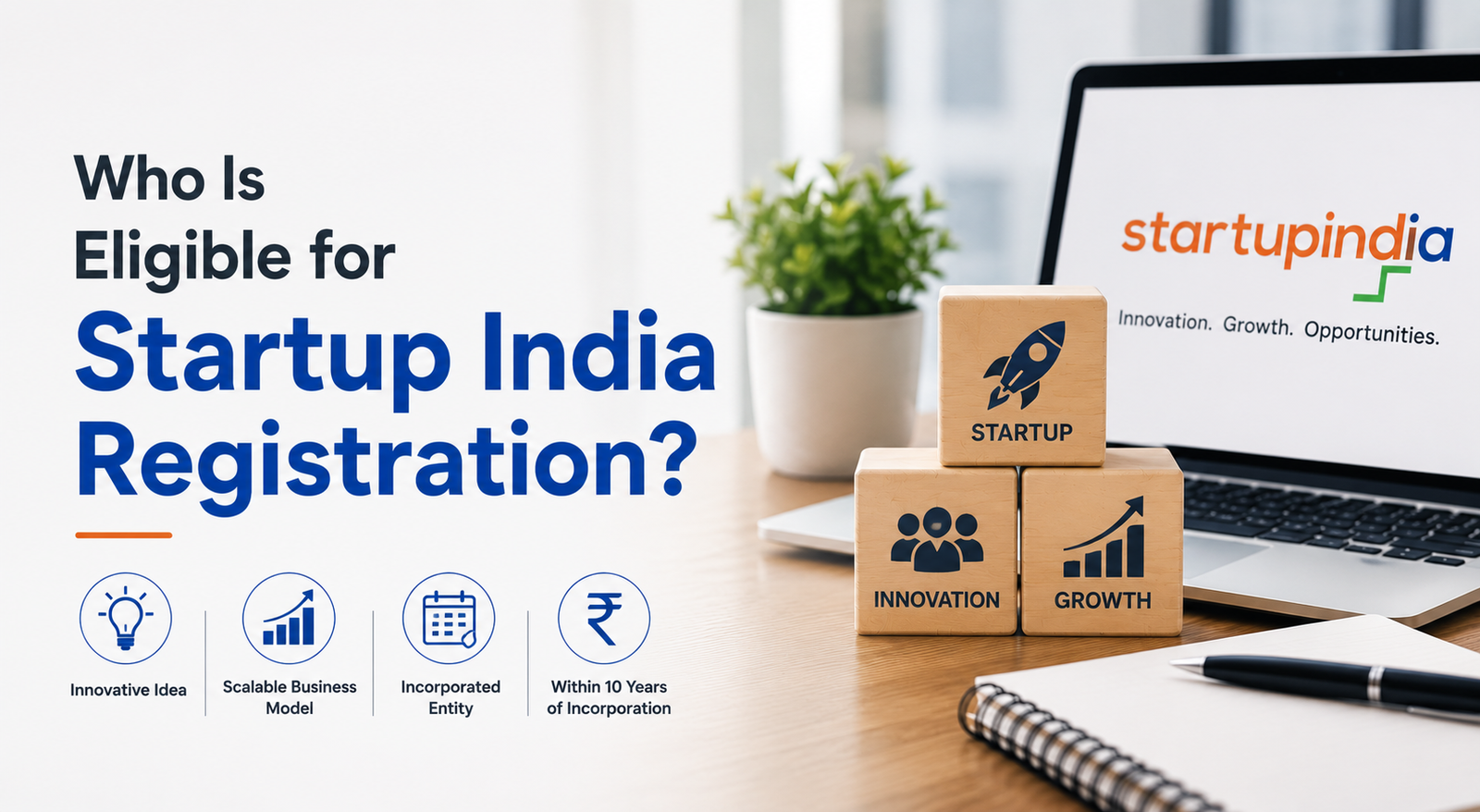
Not every business automatically qualifies for Startup India registration. Consequently, applicants must satisfy specific eligibility conditions established by authorities.
Business Age Limit
The entity should generally remain within ten years from the date of incorporation or registration.
Turnover Limit
Annual turnover must remain below the prescribed financial threshold established by government regulations.
Innovation Requirement
Businesses should focus on innovation, product improvement, process development, or scalable business models. Consequently, ordinary trading activities may not qualify for recognition.
Eligible Business Structures
Only certain business entities qualify under the initiative.
Eligible structures include:
- Private limited companies
- Limited liability partnerships
- Registered partnership firms
Businesses That May Not Qualify
Certain businesses may fail to qualify because they do not satisfy innovation or scalability requirements. Consequently, authorities carefully evaluate operational models before approval.
Businesses commonly facing rejection may include:
- Traditional retail stores
- Routine trading businesses
- Standard commission agencies
- Non-innovative service operations
- Reconstructed businesses formed through splitting existing entities
Authorities generally prioritize enterprises contributing original products, services, or technological improvements.
Benefits of Startup India Registration
Recognized startups receive multiple advantages supporting operational growth and financial stability. Consequently, many entrepreneurs seek registration during early business stages.
Tax Benefits
Eligible startups may qualify for tax exemptions under specified conditions. Moreover, these benefits may reduce financial pressure during growth stages.
Simplified Compliance
Recognized startups often receive simplified compliance procedures under labor and environmental laws.
Funding Opportunities
Government-backed schemes and investors frequently prioritize recognized startups. Consequently, access to funding may improve significantly.
Intellectual Property Support
Startups may receive support related to patent filing and intellectual property protection procedures.
Importance of Startup India Recognition for Investors
Investors often evaluate regulatory recognition before funding emerging businesses. Consequently, Startup India registration may strengthen investor confidence significantly.
Recognition demonstrates:
- Formal government acknowledgment
- Structured operational planning
- Growth-focused business models
- Regulatory compliance awareness
- Innovation-driven objectives
Consequently, recognized startups may attract stronger institutional attention during fundraising activities.
Documents Required for Startup India Registration
Applicants must provide supporting documents during the recognition process. Consequently, businesses should maintain organized records before application submission.
Commonly required documents include:
- Certificate of incorporation
- PAN details
- Director or partner identification
- Business description
- Pitch deck or presentation
- Website or product details
- Innovation explanation
- Funding information where applicable
Authorities may request additional clarification depending on business activity and operational model.
Registration Process for Startup India Recognition
The registration process primarily occurs through online government systems. Consequently, businesses can complete applications digitally with structured documentation.
Entity Formation
Businesses must first establish eligible legal entities before applying for recognition.
Application Submission
Applicants submit business information, operational details, and innovation-related descriptions through designated portals.
Document Verification
Authorities review submitted records to verify eligibility and innovation claims.
Recognition Approval
After successful evaluation, eligible businesses receive official startup recognition certificates.
Role of Innovation in Startup India Eligibility
Innovation remains one of the most important criteria during evaluation procedures. Consequently, businesses focusing solely on ordinary commercial activity may not qualify.
Authorities often evaluate:
- Product uniqueness
- Technology integration
- Operational improvements
- Scalability potential
- Market differentiation
Businesses demonstrating clear innovation objectives generally receive stronger approval consideration.
How Startup India Registration Supports Early-Stage Businesses?
Early-stage startups often face operational uncertainty, funding pressure, and regulatory complexity. Consequently, Startup India recognition may provide valuable structural support.
Reduced Compliance Burden
Simplified procedures help startups focus more on growth and operational development.
Better Market Positioning
Government recognition improves credibility among customers, vendors, and institutional partners.
Improved Funding Visibility
Investors frequently evaluate recognized startups more positively because of formal regulatory acknowledgment.
Industries Commonly Applying for Startup India Recognition
Several industries actively pursue Startup India registration because innovation and scalability remain central to their operations.
Common sectors include:
- Information technology
- Healthcare technology
- Educational technology
- Financial technology
- Logistics and supply chain
- Renewable energy
- Biotechnology
- Agricultural technology
However, eligibility depends more on innovation potential than industry category alone.
Startup India Registration for Women Entrepreneurs
Women-led startups increasingly contribute to India’s entrepreneurial growth across multiple industries. Consequently, Startup India recognition provides important institutional support for female founders.
Women entrepreneurs operating innovative and scalable businesses may access funding programs, incubation opportunities, and mentorship initiatives under startup-related schemes. Moreover, recognition strengthens business credibility during investor discussions and partnership negotiations.
Government-backed recognition may also improve visibility for women-led enterprises competing within technology, manufacturing, and service sectors.
Can Small Businesses Apply for Startup India Recognition?
Many small businesses qualify for Startup India recognition if they satisfy innovation and scalability requirements. Consequently, business size alone does not determine eligibility.
However, traditional businesses without innovative elements may not receive approval. Authorities generally prioritize enterprises introducing new products, improved services, or technology-driven operational models.
Small businesses focusing on digital transformation, automation, or market innovation may qualify even with limited operational scale during early growth stages.
Startup India Registration and Tax Advantages
Tax-related incentives remain one of the most discussed advantages associated with startup recognition. Consequently, many founders pursue registration to improve financial flexibility.
Income Tax Exemptions
Eligible startups may receive tax exemptions for specified periods under applicable regulations and approval conditions.
Capital Gains Benefits
Certain investment-related exemptions may apply to recognized startups under prescribed circumstances.
Reduced Financial Pressure
Tax incentives may support reinvestment into product development, expansion, and operational improvement during critical business stages.
However, businesses must satisfy eligibility and compliance requirements continuously to maintain benefits.
Importance of Scalability in Startup Evaluation
Scalability plays a major role during startup recognition assessment because authorities prioritize businesses capable of significant expansion. Consequently, operational growth potential influences approval decisions heavily.
Scalable businesses often demonstrate:
- Wider market applicability
- Technology-driven efficiency
- Expansion capability
- Repeatable operational models
- Long-term commercial viability
Businesses operating with limited local scope and minimal innovation may face greater difficulty during evaluation procedures.
Common Mistakes Startups Make During Registration
Several startups encounter delays or rejection because of avoidable administrative and operational mistakes. Consequently, careful preparation remains essential before application submission.
Common mistakes include:
- Weak innovation explanations
- Incomplete documentation
- Incorrect business categorization
- Limited scalability demonstration
- Poor business descriptions
- Inaccurate financial information
Startups should prepare structured operational presentations supporting innovation and growth potential clearly.
Role of Startup India Recognition During Fundraising
Fundraising remains one of the biggest challenges for emerging businesses. Consequently, Startup India recognition may strengthen investor confidence during financing discussions.
Recognized startups often appear more structured because recognition demonstrates government-backed evaluation and operational legitimacy. Moreover, investors may prefer startups maintaining organized compliance and formal registration systems.
Recognition alone does not guarantee funding approval. However, it may improve business credibility and create stronger positioning during investor presentations and venture capital discussions.
Startup India Registration and Intellectual Property Protection
Innovation-focused businesses often develop proprietary products, software, or operational systems requiring legal protection. Consequently, intellectual property support forms an important part of startup recognition benefits.
Recognized startups may receive assistance regarding:
- Patent filing
- Trademark registration
- Intellectual property awareness
- Legal support procedures
Protecting intellectual assets helps startups maintain competitive advantages and operational uniqueness within rapidly evolving commercial environments.
Compliance Responsibilities After Registration
Recognition under Startup India does not eliminate compliance responsibilities. Consequently, businesses must maintain proper records and operational transparency consistently.
Important compliance areas include:
- Accurate financial reporting
- Tax filing obligations
- Corporate law compliance
- Employee law adherence
- Updated business information
Failure to maintain proper compliance standards may affect eligibility for continued benefits and institutional support opportunities.
Startup India Recognition for Rural and Regional Enterprises
Entrepreneurship increasingly expands beyond metropolitan business centers into smaller cities and regional markets. Consequently, rural and regional startups also seek government-backed recognition for operational support and financial opportunities.
Businesses developing innovative agricultural solutions, rural technology platforms, healthcare systems, and educational services may qualify for recognition if they satisfy eligibility conditions. Moreover, regional startups often address localized challenges through scalable business models supporting broader economic development.
Government recognition may improve funding visibility and institutional access for startups operating outside traditional commercial hubs and major urban business ecosystems across India’s diverse economic landscape.
Digital Platforms and Startup Growth Opportunities
Digital transformation continues reshaping startup operations across industries. Consequently, many recognized startups rely heavily on online platforms, automation systems, and technology-driven customer engagement strategies.
Digital business models support:
- Wider customer reach
- Faster operational scaling
- Lower infrastructure costs
- Improved market visibility
- Efficient service delivery
Consequently, startups using digital systems often demonstrate stronger scalability potential during Startup India evaluation procedures and investor assessments across competitive business environments requiring rapid adaptation and innovation-focused commercial growth.
Importance of Structured Business Planning
Structured planning significantly improves startup stability and recognition opportunities. Consequently, businesses should maintain clear operational frameworks before applying for startup recognition.
Strong planning generally includes:
- Defined business objectives
- Revenue strategies
- Market analysis
- Product positioning
- Financial forecasting
- Expansion planning
Authorities and investors frequently evaluate operational clarity during recognition and funding procedures. Therefore, organized business planning strengthens credibility and long-term commercial sustainability significantly.
Conclusion
Startup India registration provides valuable support for innovative businesses seeking growth, funding, and operational stability. Consequently, technology startups, manufacturing enterprises, service providers, and scalable businesses often benefit from official recognition. Tax advantages, compliance support, funding visibility, and intellectual property assistance represent important advantages associated with the initiative. Businesses should carefully evaluate eligibility, maintain accurate records, and present strong innovation-focused operational models during application procedures. Proper recognition ultimately strengthens credibility, encourages entrepreneurship, and supports sustainable commercial growth across India’s expanding startup ecosystem and competitive business environment.
FAQs
1. Who can apply for Startup India registration?
Eligible private limited companies, limited liability partnerships, and registered partnership firms may apply if they focus on innovation, scalability, or product improvement. Consequently, startups operating within prescribed turnover and age limits often qualify for recognition under the Startup India initiative established by government authorities.
2. Is Startup India registration mandatory for every startup?
No, registration remains voluntary rather than mandatory. However, eligible startups often seek recognition because it provides tax benefits, funding opportunities, simplified compliance procedures, and improved business credibility. Consequently, many entrepreneurs pursue registration during early operational stages to strengthen long-term growth potential and institutional visibility.
3. Can traditional retail businesses receive Startup India recognition?
Traditional retail businesses usually face difficulty qualifying unless they demonstrate strong innovation or scalable operational models. Authorities generally prioritize startups developing unique products, technological solutions, or process improvements. Consequently, ordinary trading operations without innovation-focused objectives may not satisfy recognition requirements under evaluation procedures.
4. What documents are necessary for Startup India registration?
Applicants generally require incorporation certificates, PAN details, founder identification documents, business descriptions, and innovation-related explanations. Moreover, startups may submit presentations, product details, and operational summaries supporting scalability and uniqueness. Accurate documentation significantly improves application quality and reduces procedural delays during evaluation stages.
5. Does Startup India recognition help with funding opportunities?
Yes, recognized startups often gain improved visibility among investors, incubators, and government-backed funding programs. Consequently, formal recognition may strengthen credibility during fundraising discussions. However, businesses still require strong operational planning, market potential, and financial strategies to secure actual investment support from institutional sources.
6. How long can a business remain eligible as a startup?
Businesses generally remain eligible for Startup India recognition for up to ten years from incorporation, subject to applicable regulations. Moreover, turnover must remain within prescribed financial thresholds. Startups exceeding eligibility limits may lose recognition status and associated benefits under government operational policies and compliance frameworks.
7. Can service-based startups qualify for Startup India recognition?
Yes, service-based startups may qualify if they demonstrate innovation, scalability, or technology-driven operational improvements. Consequently, businesses operating in digital services, healthcare technology, education platforms, logistics systems, and consultancy innovation sectors often receive recognition consideration under the Startup India initiative and related evaluation procedures.
8. What role does innovation play during startup evaluation?
Innovation forms one of the most important eligibility criteria during recognition assessment. Authorities evaluate uniqueness, technological integration, operational improvements, and scalability potential carefully. Consequently, startups presenting innovative products, services, or business models generally receive stronger approval consideration compared to ordinary commercial operations without differentiation strategies.
9. Can startups from smaller cities apply for Startup India recognition?
Yes, startups operating from smaller cities and regional areas may apply if they satisfy eligibility requirements. Consequently, innovative businesses from non-metropolitan regions increasingly receive recognition across agriculture, education, healthcare, and digital sectors supporting local and national economic development opportunities effectively and sustainably throughout India.
10. Why do startups consider Startup India recognition important?
Recognition improves credibility, funding visibility, compliance support, and operational legitimacy for emerging businesses. Moreover, eligible startups may access tax incentives, intellectual property assistance, and government-backed schemes. Consequently, many entrepreneurs view Startup India recognition as an important step toward sustainable commercial growth and long-term business expansion.





Leave a Reply