
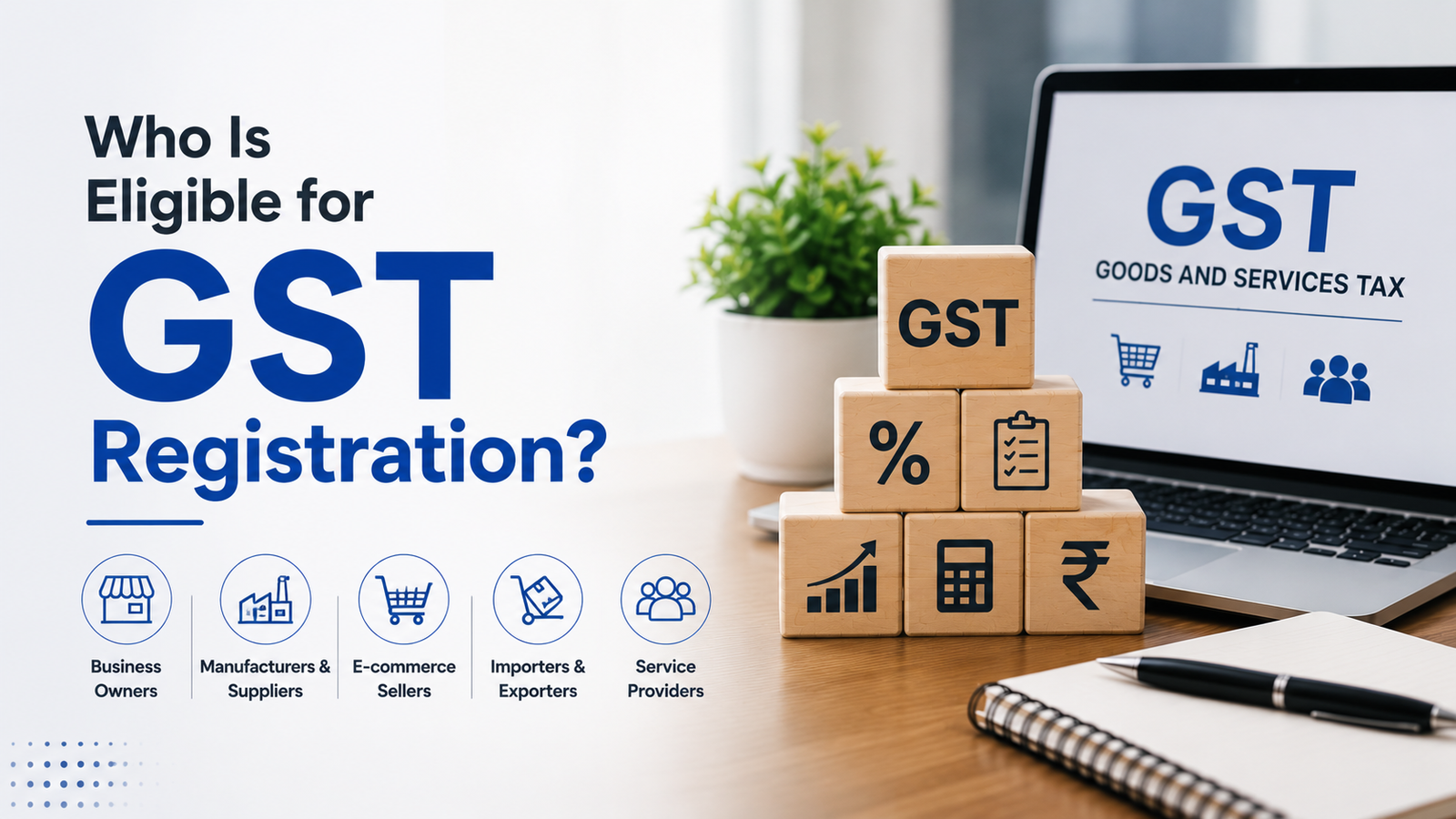
Goods and Services Tax (GST) plays a central role in India’s indirect tax system. Businesses that supply goods or services must determine whether they need GST registration based on turnover, business activities, and legal requirements. Many entrepreneurs ask, “Who Is Eligible for GST Registration?” because registration affects taxation, invoicing, compliance, and business growth. While some businesses register voluntarily, others must obtain registration under the law. Knowing the eligibility criteria helps businesses avoid penalties and maintain smooth operations.
What Is GST Registration?
GST registration is the process through which a business becomes recognized under the GST framework and receives a unique Goods and Services Tax Identification Number (GSTIN). This registration enables a business to collect GST from customers, claim input tax credit, and comply with tax regulations.
Once registered, a business must file GST returns within prescribed timelines. Moreover, registration increases credibility and allows companies to conduct transactions with larger organizations that often prefer dealing with GST-registered suppliers.
Businesses should evaluate their operations carefully before determining whether registration is mandatory or optional.
Who Is Eligible for GST Registration?
The answer to “Who Is Eligible for GST Registration?” depends on several factors, including annual turnover, nature of business, location, and transaction type.
A person or entity may become eligible for GST registration if:
- Annual turnover exceeds prescribed limits.
- Interstate taxable supplies are made.
- Business operates through e-commerce platforms in specified situations.
- Tax collection or tax deduction obligations apply.
- The business falls under mandatory registration categories.
- Voluntary registration is preferred despite lower turnover.
Consequently, eligibility does not depend solely on revenue. Certain business activities trigger registration requirements even when turnover remains below threshold limits.
Turnover-Based Eligibility for GST Registration
Turnover remains one of the most important criteria for GST registration.
For Businesses Supplying Goods
Businesses supplying goods generally become liable for GST registration when their aggregate turnover exceeds the prescribed threshold limit applicable in their category and state.
Aggregate turnover includes:
- Taxable supplies
- Exempt supplies
- Exports
- Interstate supplies
However, taxes charged under GST are excluded while calculating aggregate turnover.
For Businesses Supplying Services
Service providers also become eligible when their annual turnover crosses the applicable threshold prescribed under GST regulations.
Because threshold limits may vary depending on government notifications and business classification, taxpayers should regularly review current requirements before making compliance decisions.
Importance of Monitoring Turnover
Many businesses begin operations on a small scale. Nevertheless, growth can occur rapidly.
Business owners should:
- Review monthly revenue figures.
- Monitor cumulative annual turnover.
- Maintain proper accounting records.
- Assess future business expansion plans.
As a result, timely registration helps avoid legal complications and financial penalties.
Mandatory GST Registration Categories
Certain persons must obtain GST registration regardless of turnover.
Interstate Suppliers
Businesses making taxable interstate supplies may require registration under applicable GST provisions.
For example, if a supplier located in one state provides taxable goods or services to customers in another state, registration obligations may arise.
E-Commerce Operators
E-commerce operators engaged in facilitating online transactions often fall under mandatory registration requirements.
Since online marketplaces connect buyers and sellers across different locations, GST compliance becomes particularly important.
Tax Deductors and Tax Collectors
Entities responsible for tax deduction at source (TDS) or tax collection at source (TCS) must register under GST when required by law.
Therefore, government bodies and specific organizations frequently obtain registration for compliance purposes.
Non-Resident Taxable Persons
Individuals or businesses operating in India without a fixed place of business may require GST registration before conducting taxable activities.
Moreover, such persons often follow separate registration procedures and compliance requirements.
Input Service Distributors
Organizations distributing input tax credits among branches must obtain GST registration as Input Service Distributors.
Consequently, businesses with multiple operational units often utilize this mechanism for efficient tax credit allocation.
Eligibility for GST Registration by Business Structure
GST registration eligibility applies across various business structures.
Proprietorship Firms
A sole proprietor becomes eligible when turnover exceeds applicable thresholds or when mandatory registration conditions arise.
Many small traders and service providers operate under this structure.
Partnership Firms
Partnership businesses must obtain GST registration when legal conditions are satisfied.
Furthermore, all partners should ensure proper compliance and record maintenance.
Limited Liability Partnerships
LLPs engaged in taxable supplies may require GST registration depending on turnover and business activities.
Because LLPs often serve professional and commercial sectors, GST compliance becomes an important operational requirement.
Private Limited Companies
Companies frequently obtain GST registration due to larger transaction volumes and extensive commercial activities.
Additionally, many corporate clients prefer dealing with registered suppliers.
Public Limited Companies
Large organizations generally maintain GST registration because of substantial turnover and nationwide operations.
As a result, registration becomes a standard compliance requirement.
Voluntary GST Registration
Not every registered business crosses the mandatory turnover threshold. Some organizations choose voluntary registration.
Benefits of Voluntary Registration
Voluntary registration offers several advantages:
- Ability to claim input tax credit.
- Improved business credibility.
- Better opportunities with corporate clients.
- Easier interstate business expansion.
- Stronger market presence.
Consequently, startups and emerging enterprises often register voluntarily to strengthen their competitive position.
Responsibilities After Voluntary Registration
Once registered voluntarily, businesses must comply with GST regulations just like entities registered mandatorily.
Responsibilities include:
- Filing returns.
- Maintaining records.
- Issuing tax invoices.
- Paying applicable taxes.
Therefore, voluntary registration should be evaluated carefully before submission.
Eligibility for GST Registration for Online Businesses
Digital commerce continues to expand across India.
Many online businesses ask whether GST registration is necessary.
Online Sellers
Online sellers offering products through marketplaces may need registration depending on applicable legal provisions and transaction structures.
Moreover, marketplace requirements often influence registration decisions.
Digital Service Providers
Freelancers, consultants, software professionals, and digital marketers should evaluate turnover and transaction patterns to determine registration obligations.
Because digital services frequently involve interstate transactions, compliance assessment becomes essential.
Export-Oriented Businesses
Exporters may register under GST to access benefits related to tax compliance and input tax credit mechanisms.
Consequently, registration often supports smoother international business operations.
Who Is Not Required to Register Under GST?
Not every business requires GST registration.
Several categories may remain outside mandatory registration requirements.
Businesses Below Threshold Limits
Businesses with turnover below applicable thresholds generally may not require registration unless specific mandatory provisions apply.
Entities Dealing Exclusively in Exempt Supplies
Businesses engaged entirely in exempt goods or services may not need GST registration.
However, owners should verify whether any taxable supplies exist before making a final determination.
Agricultural Activities
Certain agricultural activities receive special treatment under GST provisions.
As a result, many agriculturists supplying produce from cultivation may not require registration for those activities.
Specified Exempt Categories
Government notifications occasionally provide exemptions to particular categories of persons or businesses.
Therefore, reviewing applicable notifications remains important.
Documents Required for GST Registration
Eligible applicants generally need supporting documentation.
Common requirements include:
- PAN card
- Aadhaar details
- Business address proof
- Identity proof
- Photographs
- Bank account information
- Authorization documents where applicable
Accurate documentation helps prevent delays during processing.
Furthermore, businesses should ensure consistency across all submitted records.
Common Mistakes While Assessing GST Eligibility
Many businesses make errors while determining eligibility.
Some frequent mistakes include:
- Ignoring aggregate turnover calculations.
- Delaying registration after crossing limits.
- Misclassifying supplies.
- Overlooking interstate transactions.
- Failing to maintain proper records.
- Assuming exemptions without verification.
Consequently, businesses should review eligibility periodically and seek professional assistance when necessary.
Benefits of Obtaining GST Registration
GST registration offers advantages beyond legal compliance.
Input Tax Credit
Registered businesses can claim eligible input tax credits on purchases used for business purposes.
Therefore, overall tax costs may reduce significantly.
Business Expansion
Registration supports expansion into new markets and commercial opportunities.
Moreover, registered status often enhances customer confidence.
Participation in Formal Economy
GST registration enables businesses to operate within a recognized regulatory framework.
As a result, access to financing and business partnerships may improve.
Improved Record Keeping
Compliance requirements encourage systematic accounting practices.
Consequently, financial management becomes more organized and transparent.
Penalties for Failure to Register
Businesses that fail to obtain registration when required may face consequences.
Potential issues include:
- Monetary penalties.
- Interest liabilities.
- Compliance notices.
- Operational disruptions.
- Increased scrutiny from authorities.
Therefore, businesses should monitor eligibility conditions continuously and act promptly when registration becomes necessary.
How to Determine Whether Registration Is Necessary
Business owners should evaluate multiple factors before reaching a conclusion.
Important considerations include:
- Annual turnover.
- Nature of supplies.
- Interstate transactions.
- Business structure.
- E-commerce involvement.
- Applicable exemptions.
Additionally, reviewing regulatory updates helps maintain ongoing compliance.
A proactive approach reduces uncertainty and minimizes the risk of penalties.
Conclusion
The question “Who Is Eligible for GST Registration?” requires careful evaluation of turnover, business activities, transaction patterns, and statutory obligations. While many businesses qualify after crossing prescribed limits, others must register because of specific operational requirements. Proper assessment helps organizations remain compliant, avoid penalties, and benefit from the advantages that GST registration provides. Businesses should review their eligibility regularly and maintain accurate records to support smooth and lawful operations.
FAQs
1. What does GST registration mean?
GST registration is the process through which a business obtains a GSTIN and becomes recognized under the GST system. Registration allows eligible entities to collect GST, claim input tax credit, issue tax invoices, and comply with return filing obligations according to applicable tax laws.
2. Who Is Eligible for GST Registration?
Eligibility depends on turnover, nature of business activities, interstate transactions, and specific legal requirements. Some businesses must register after crossing prescribed turnover limits, while others require registration regardless of turnover due to their operational category or transaction structure.
3. Can a small business apply voluntarily for GST registration?
Yes. A small business can seek voluntary registration even when turnover remains below mandatory limits. Voluntary registration enables access to input tax credits, improves credibility, and may support business expansion opportunities in competitive markets.
4. Is GST registration mandatory for online sellers?
Online sellers may require GST registration depending on marketplace involvement, transaction type, and applicable regulations. Businesses operating through digital platforms should evaluate legal requirements carefully to determine whether registration obligations apply to their activities.
5. What is aggregate turnover under GST?
Aggregate turnover generally includes taxable supplies, exempt supplies, exports, and interstate supplies calculated on an all-India basis. GST charged on invoices is usually excluded while calculating aggregate turnover for determining registration eligibility.
6. Can service providers become eligible for GST registration?
Yes. Service providers become eligible when turnover exceeds applicable thresholds or when mandatory registration conditions apply. Consultants, freelancers, and professional service firms should monitor turnover regularly to ensure compliance with GST requirements.
7. What documents are generally needed for GST registration?
Applicants commonly provide PAN details, identity proof, address proof, bank account information, photographs, and business-related documents. Accurate documentation helps authorities verify information and process registration requests efficiently.
8. Are exempt businesses required to obtain GST registration?
Businesses dealing exclusively in exempt supplies may not require registration in many cases. However, owners should review applicable regulations carefully because additional activities or changes in business operations could affect eligibility requirements.
9. What happens if a business delays GST registration?
Delayed registration can lead to penalties, interest liabilities, compliance notices, and administrative complications. Therefore, businesses should monitor turnover and registration triggers consistently to avoid unnecessary legal and financial consequences.
10. Why is GST registration beneficial for growing businesses?
GST registration improves credibility, facilitates input tax credit claims, supports expansion opportunities, and strengthens compliance. Moreover, many larger clients prefer working with registered businesses, making registration advantageous for long-term growth strategies.




Leave a Reply